About Team Mo's Cancer Moonshot
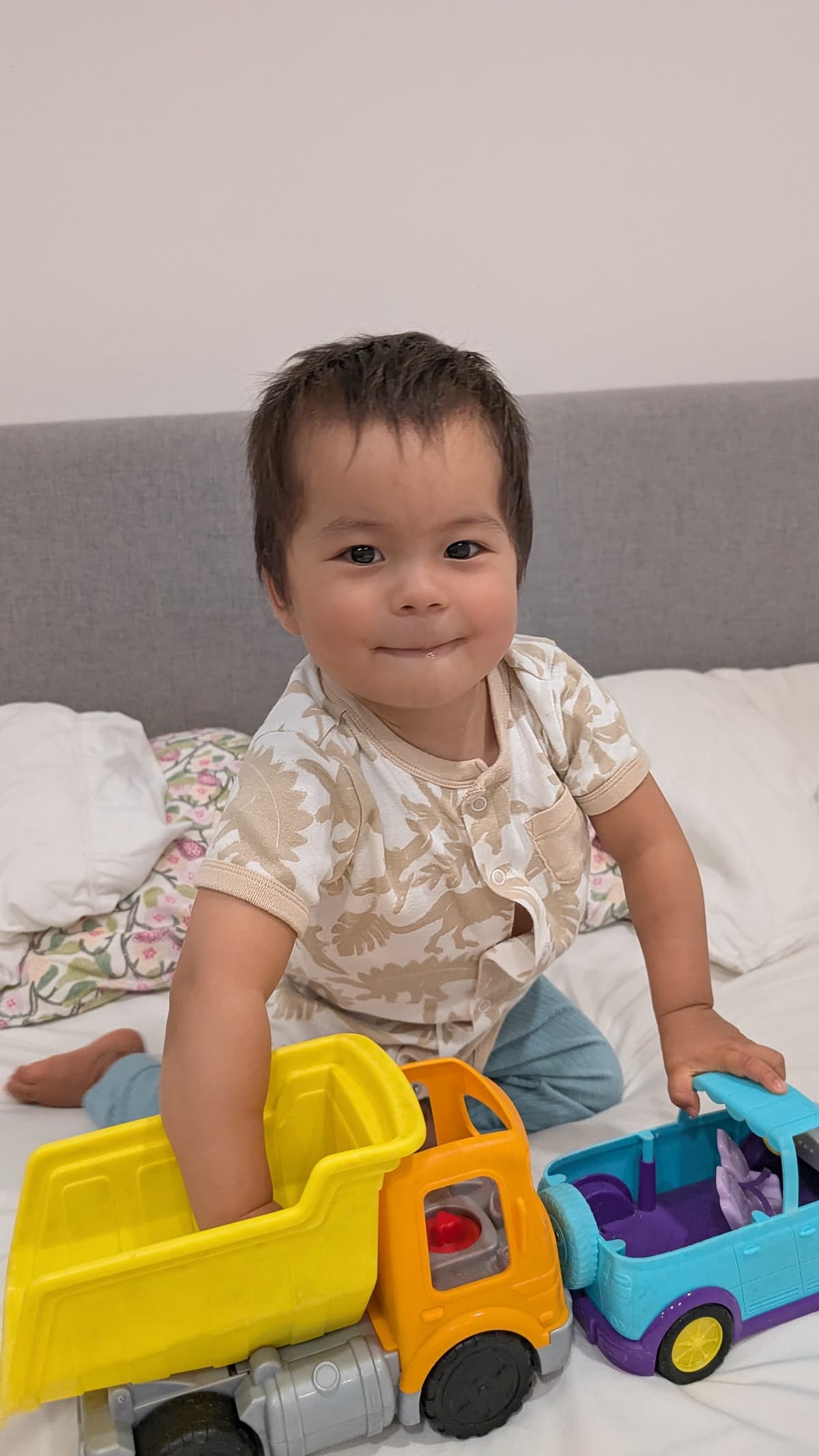
Baby "Mo" is our 2-year-old son, a bright and curious little boy who loves Cocomelon, anything with wheels, and being silly with his family. His gentle smile brings comfort and light to everyone he meets, even during hard moments. He has faced more than most 26-month-olds ever should. Despite every challenge, he keeps growing and learning. He knows his letters, numbers, animals, and shapes, and he shows more of his own personality each day. We root for him to beat this cancer and grow into the person he already shows us he is, in ways far beyond anything I could be. We are in this fight with everything we have.
Since birth, our world has been turned upside down by an ultra‑rare low‑grade tumor that has recently transformed into an aggressive EGFR‑driven sarcoma with no “standard playbook” for his cancer.
Every step forward requires not only chemotherapy and radiation, but also cutting‑edge genomic sequencing, expert second opinions, and experimental science just to keep options alive. We are fighting his cancer at the frontiers of medicine—pursuing deep molecular profiling, ex vivo drug testing, potential immunotherapies, and personalized approaches that simply did not exist a few years ago.
These paths offer real hope, but they are not covered by insurance, and the costs of expert consultations; deep genomic, molecular, and single‑cell analyses; travel; specialized testing; and coordination between centers add up quickly. “It takes a village to raise a child,” and, in our case, it takes a village to help save one. Your support helps us unlock critical biopsies, advanced sequencing, and access to trials and scientists who may transform data into real options for Mo’s future.
While Mo continues with chemotherapy, in the coming weeks, Mo faces several critical scans, biopsies, and treatment decisions that will shape the rest of his life. We are racing against time to explore every viable path—standard and experimental—so that when those decisions arrive, we are ready with the best possible options for him. Every contribution—whether financial, a share, or a message of encouragement—becomes part of that village standing with him. Thank you for being part of Mo’s story and for helping us fight for more time, more discoveries, and more tomorrows with our little boy.
What We’re Trying to Fund
We’re setting an initial goal of $100,000 (initial projections ~$305,000+) to push beyond standard care and aggressively pursue a cure for our son’s cancer. Many researchers and clinicians have reached out to support. This is a moonshot, and it will take a community to carry the vision forward. Below is a realistic breakdown of where this money could go. Email TEAMMO.CANCER@GMAIL.COM to discuss coordinating Donor-Advised Funds and/or Corporate Matching gifts and other creative/innovative ideas!
1. Advanced Genomic and Single-Cell Profiling Approx. $35,000
Whole-genome / whole-exome sequencing (repeat or deeper runs)
For tumor + blood, often not fully covered or only once. Estimated: $15,000
Whole-transcriptome RNA-seq + targeted deep sequencing of EGFR and other loci To look for resistance mechanisms, rare alterations, and new targets. Estimated: $10,000
Single-cell or spatial transcriptomics on new biopsy tissue To map tumor heterogeneity and immune microenvironment in detail. Estimated: $10,000
2. Functional and Preclinical Work (Lab Models & Drug Screens) Approx. $90,000
Establishing patient-derived models (organoids, cell lines, or PDX) in academic labs Lab setup, animal costs, consumables. Estimated: $50,000 (Patient Derived Xenograft with 2 arms + control)
Custom ASO design against EGFR (Research team in Singapore's time and reagents). Estimated: $17,500
Custom drug screening against EGFR/other pathways. Small focused panels, including off-label and experimental agents. Estimated: $15,000
Data analysis support (bioinformatics, computational collaborators) To interpret complex sequencing and model data fast enough to still matter. Estimated: $7,500
3. Targeted Diagnostics, Pathology, and Second Opinions Approx. $40,000
Expert consultations and second-opinion reviews. We plan to request about five expert reviews across leading centers such as MSK, Utrecht, CHOP, and Dana-Farber. These reviews include pediatric oncology, surgical oncology, and pathology input to guide treatment decisions. Estimated cost is $6,000 per consultation, or about $30,000 total.
Specialized tumor testing and pathology work. This includes advanced immunohistochemistry stains such as B7-H3, GD2, HER2, and others performed at multiple centers. Costs cover slide and tissue block shipping, consultation fees, and repeat staining when needed. Estimated total ranges ~$10,000.
4. Clinical Trial, Travel, and Off-Protocol Care Gaps Approx. $25,000
Travel and lodging for trial evaluations or out-of-state and out-of-country expert consults, flights, hotels, ground transport for multiple trips. Estimated: $15,000
Non-covered medications or bridging therapies Off-label targeted agents, immunotherapy adjuncts, or compounded drugs that fall outside standard coverage. Estimated: $10,000
Additional Items
5. Real-Time Monitoring and Minimal Residual Disease (MRD) Tools Approx. $20,000
- Serial liquid biopsy (ctDNA NGS panels) for MRD tracking and early detection of resistance/emerging subclones (e.g., via Guardant360 or MSK-IMPACT liquid). Repeat every 1-3 months during treatment. Estimated: $10,000 (4-6 tests at commercial labs).
- AI-driven computational analysis of serial data to predict progression (e.g., via partnerships with Broad Institute or AI platforms like Tempus AI). Includes bioinformatics consulting. Estimated: $10,000.
- Comprehensive plans often stop at initial profiling; MRD tools (highlighted in 2025 AACR Pediatric Progress Report) enable adaptive therapy adjustments, potentially catching transformations early.
6. Immunotherapy and Novel Modality Exploration Approx. $50,000
- Custom neoantigen vaccine or TCR-T cell therapy feasibility study (e.g., via MSK or CHOP's Very Rare Malignant Tumors Program, including HLA typing and antigen prediction). Estimated: $25,000 (preclinical design phase).
- Radioligand or oncolytic virus therapy screening (e.g., targeting B7-H3 or EGFR with lutetium-based agents, per recent rare sarcoma advances). Includes specialized imaging/PET. Estimated: $15,000.
- Microbiome/epigenetic profiling (e.g., gut microbiome sequencing + methylation arrays) to identify modifiable factors influencing tumor response. Estimated: $10,000.
- 2025 studies (e.g., pembrolizumab in ultra-rare sarcomas) show immunotherapies outperforming in heterogeneous tumors; these bridge gaps in PDX models by addressing immune evasion.
7. Global Data-Sharing and Registry Enrollment Approx. $15,000
- Enrollment in international rare cancer registries/networks (e.g., Joint Action for Rare Cancers - JARC, or NCI's Childhood Cancer Data Initiative) with data upload/collaboration fees. Includes virtual consults with European experts (e.g., DKFZ Heidelberg). Estimated: $7,500.
- Participation in patient-derived data platforms (e.g., Project EveryChild or CAC2 initiatives) for aggregating ultra-rare cases, with bioinformatics support for sharing anonymized sequencing. Estimated: $7,500.
- National plans often overlook global data silos; 2025 reviews (e.g., Lancet on rare cancers) emphasize registries for uncovering patterns in <50-case cohorts, potentially matching your son's profile to new trials.
8. Gene Editing and Drug Repurposing Pilots Approx. $30,000
- CRISPR-based functional genomics screening on patient-derived cells (e.g., via academic labs like Stanford or Broad, targeting EGFR dependencies). Estimated: $15,000.
- AI-assisted drug repurposing library screen (e.g., using platforms like Atomwise or Recursion Pharma for off-label matches). Estimated: $15,000. - Emerging differentiation therapies (e.g., Northwestern's 2025 sarcoma work) and gene editing address root causes beyond TKIs; often absent in plans focused on sequencing alone.
Why $100,000 and Why a “Moonshot”?
$100,000 is not a random number; it’s the order of magnitude required to: Run cutting-edge sequencing and single-cell work that can reveal targets standard panels miss. Build patient-derived models and run focused drug screens that might identify a drug combination uniquely effective for his tumor. Access national experts and trials, plus pay for the non-covered pieces that sit between “what insurance will do” and “what it takes to actually move the needle.” This is a moonshot because we are trying to do what standard protocols alone cannot: Turn every biopsy, every data point, and every collaboration into a personalized map toward a cure or durable control. Move faster than the cancer by front-loading the science, logistics, and expert input. We absolutely cannot do this alone. It will take a community—family, friends, colleagues, and people who simply believe that one small boy’s life is worth pushing the boundaries for—to unlock this vision.
For Donor-Advised Funds & Matching Gifts (
For offline donations and to avoid the fees from GoFundMe: Checks can be mailed directly to Rare Village at 6808 Old Glory Ct., McKinney, TX 75071, EIN: 83-4699994, with "Team Mo" in the memo line.
We are partnering with Rare Village Foundation (EIN 83‑4699994), a 501(c)(3) nonprofit that supports families of children with rare and serious conditions. Gifts made through Rare Village for "Team Mo" are tax‑deductible to the fullest extent allowed by law. If you have a donor-advised fund (DAF) (Fidelity, Schwab, Vanguard, community foundation, etc.) or a family foundation, you can recommend a grant using the following information: Charity name: Rare Village Foundation EIN: 83‑4699994 Designation / note: “Team Mo” This ensures your support goes into Mo’s dedicated fund at Rare Village to help cover his medical, travel, and precision‑medicine research costs. If your employer offers matching gifts, you can also direct matches to Rare Village Foundation (EIN 83‑4699994) with “Team Mo” in the notes or program description. This can double or even triple the impact of your support for our son.